

Website
Marketing or brochure site
$950 – $1,700
5–7 weeks
 DRAG
DRAG 
 Webzact Webzact
Estimate the cost of a website, e-commerce store, web app or mobile app in about two minutes. Answer a few simple questions and get a realistic price range, a line-by-line breakdown and a delivery timeline.
Pick the closest match — the questions after this adapt to your answer.
Choose what you're building to continue.
Rough answers are fine. We're sizing the job, not writing the spec.
Please answer every question above to continue.
Optional. Skip anything you already have covered — you can leave them all off.
Timing changes the price, so here is exactly how much and why.
Three steps, about two minutes, and no email address needed.
Pick from 14 project types — from a landing page or business website to an online store, mobile app or custom software.
Tell us the rough scope: pages, features, integrations, optional add-ons and how soon you need it. Ballpark answers are fine.
See a price range, a line-by-line cost breakdown and a delivery timeline straight away — in any of 24 currencies.
Prefer to work it out by hand? Read our 5-step guide to estimating website development cost.
What a mid-sized project of each type costs on a standard timeline, with no add-ons. Figures in USD, produced by the same engine as the calculator — your own answers will move them.
Marketing or brochure site
$950 – $1,700
Selling products or services online
$1,750 – $3,200
SaaS, dashboard or internal tool
$3,000 – $6,000
iOS, Android or both
$3,300 – $6,650
One page, built to convert
$300 – $600
Built on WordPress, edited by you
$750 – $1,450
Internal system for how your business runs
$5,850 – $12,800
Many sellers, one platform
$5,550 – $12,200
Courses, students and progress
$3,400 – $7,550
Appointments, slots and reminders
$1,700 – $3,800
Design handed over, built by others
$800 – $1,950
The engine behind someone else’s front end
$1,950 – $4,350
Answer questions and automate the repetitive work
$1,050 – $2,500
Tell us the shape and we will size it
$1,250 – $2,600
The questions change with what you are building, so every kind of project is priced on the things that actually drive its cost.
For business websites, landing pages and WordPress sites. It asks roughly how many pages you need, whether you want a template or a custom design, if your team will edit the content, and how many languages the site needs.
Typical business website: $950 – $1,700 Web design & developmentFor online stores on Shopify, WooCommerce or a custom build. It prices in your platform, how many products you sell, how many payment methods you accept, and whether you need subscriptions or more than one currency.
Typical online store: $1,750 – $3,200For iOS, Android and cross-platform mobile apps. It covers which platforms you need, native or cross-platform, the backend behind the app, offline mode and push notifications.
Typical mobile app: $3,300 – $6,650 Mobile app developmentFor web applications, SaaS products, custom CRMs, marketplaces, booking systems, learning platforms, APIs and AI chatbots. It sizes user roles, logins, dashboards, integrations and real-time features.
Typical web application: $3,000 – $6,000 Laravel developmentSix things move the price more than anything else. Knowing them makes any quote easier to read.
Ten pages that share one template cost far less than four pages that each behave differently. What drives the number is how many distinct things have to be designed, built and tested — not how many URLs exist.
Adapting a well-chosen template is the biggest saving available on a small project. Custom design costs more because it is drawn, reviewed and revised from scratch — worth it when the brand is the product.
Every third-party service — payments, CRM, shipping, accounting — is its own small project: read the documentation, handle the failure cases, test against a sandbox, then test again.
A site your team updates without a developer needs a content management layer that has to be built and explained. It adds to the build and pays for itself the first time you avoid a change request.
Compressing a schedule does not make the work smaller, it makes it parallel — more people, more coordination, more review. That is why expedited delivery costs more rather than less.
Hosting, monitoring, security updates and support are ongoing costs, not build costs. They are easy to forget at quote stage, so decide early whether they are yours or ours.
Pricing, estimating and timelines explained in plain English.

How much does a website cost in 2026? Learn website development costs, pricing factors, ecommerce costs, and what to expect b...
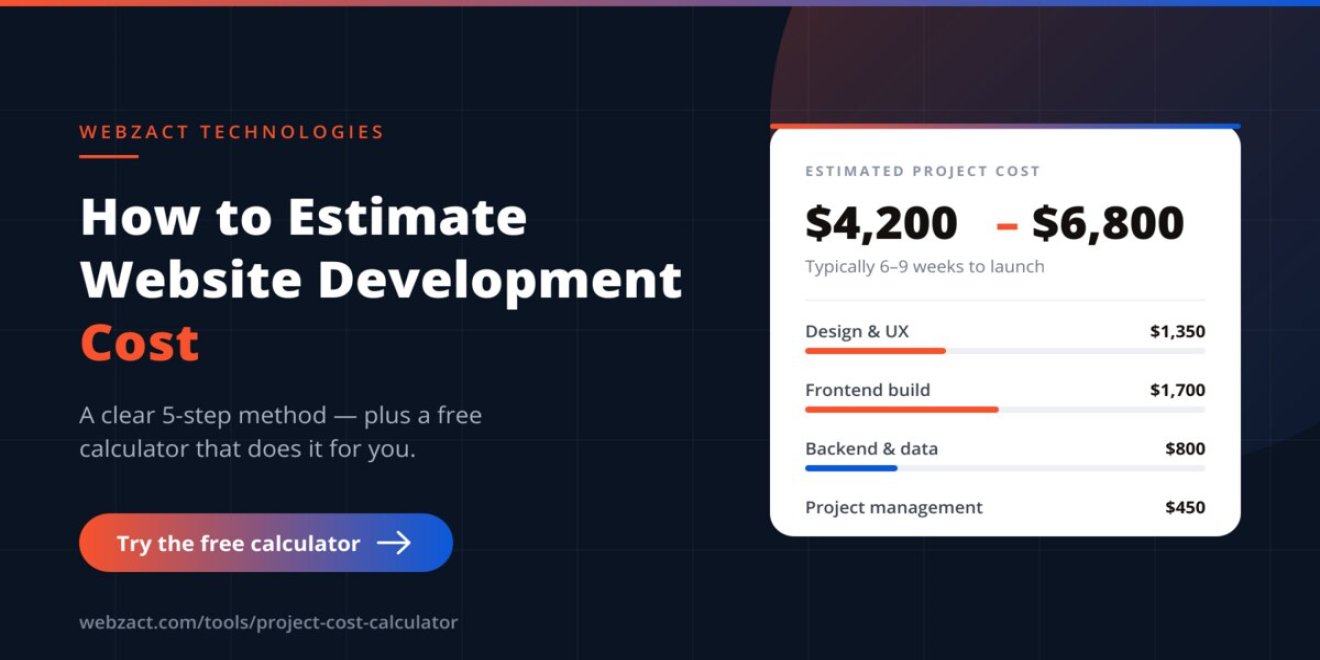
Learn how to estimate website development cost in five steps — scope, design, integrations, extras and timeline. Includes a f...
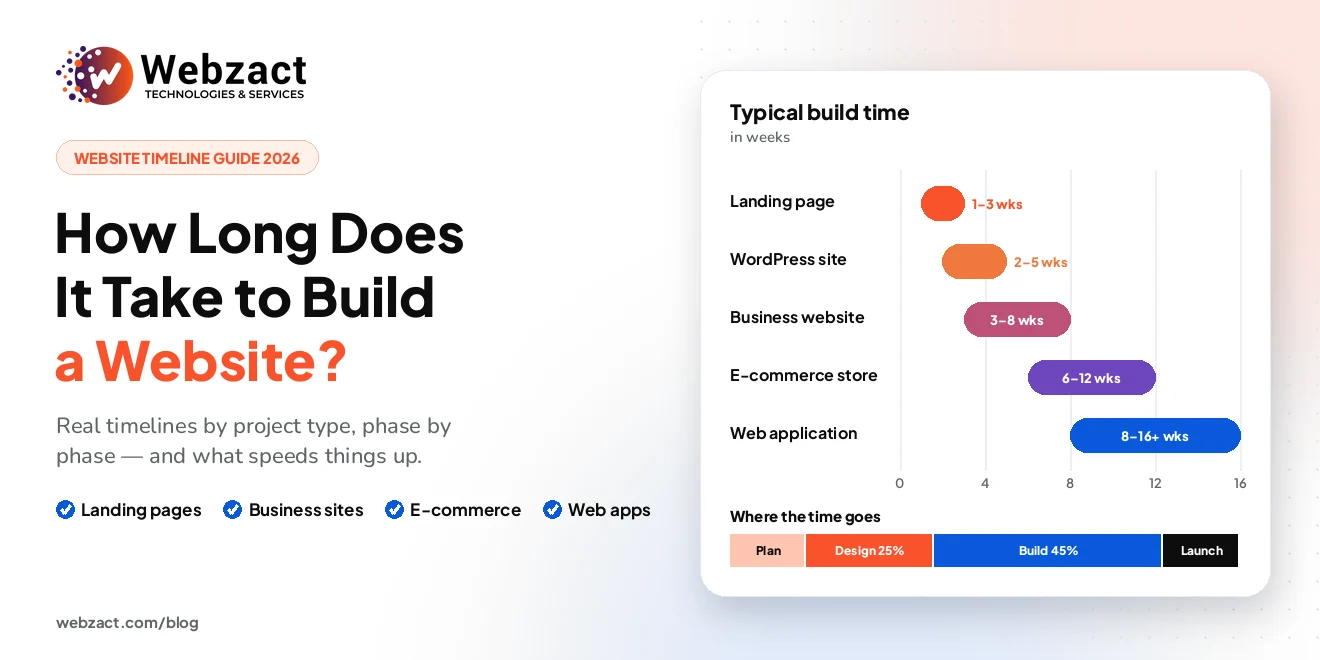
How long does it take to build a website? Most take 2–16 weeks. See the website development timeline by project type and phas...
Straight answers about pricing, accuracy and how the estimate works.
A typical business website costs $950 – $1,700 and takes 5–7 weeks to build — that is a mid-sized site on a standard timeline. A single landing page costs around $300 – $600. A WordPress website costs around $750 – $1,450. Use the calculator above to price your own pages, design and features.
A typical mobile app costs $3,300 – $6,650 and takes 11–17 weeks. Building for both iOS and Android, a custom backend, offline mode and push notifications all add to the price, while a cross-platform approach usually keeps it lower.
A typical online store costs $1,750 – $3,200. Shopify is usually the most affordable route, while WooCommerce and fully custom stores cost more as your product count, payment methods and subscription features grow.
A typical web application costs $3,000 – $6,000. Larger internal systems, such as a custom CRM or ERP, cost around $5,850 – $12,800. The number of user roles, integrations, real-time features and admin tools has the biggest effect on the price.
It gives a realistic range for a project of the shape you describe, based on how projects like it are actually built. It is not a quote: a few questions cannot capture everything that moves a price, such as exact integrations, the state of your content and how decisions get approved. Expect the final figure to land inside the range once those are known — a short call usually narrows it considerably.
No. Your estimate appears as soon as you answer the questions. We only ask for an email afterwards if you want the breakdown sent to you, a detailed proposal or a call — and none of those are required.
A typical business website takes 5–7 weeks, a landing page 2–4 weeks and a web application 11–17 weeks. Every estimate from the calculator includes a delivery timeline split into phases. Read our website timeline guide.
Yes. The result screen lets you switch between 24 currencies, including USD, PKR, INR, BDT, LKR, NPR, and your choice is remembered next time you use the calculator.
Because a single number would be false precision. Nobody can price software to the dollar from a few questions, and a figure that a later conversation contradicts costs trust. The range is the honest answer to what you told us.
No. An estimate is our informed expectation based on a few answers; a quote is a commitment against a written scope. The estimate costs nothing and commits you to nothing — a short call is how we turn it into a proposal.
A free 15-minute call is usually enough to narrow the range and map out the next steps. No pressure, no obligation.
Typically from kickoff to launch
A number with no reasoning behind it is not much use. Here's how the work divides up.
| Line item | Estimated range |
|---|---|
| Total |
Phases overlap in practice — this is the shape, not a Gantt chart.
This is an estimate based on typical projects of this shape. Final pricing depends on detailed requirements — a 15-minute call usually narrows it considerably, and costs you nothing.
We'll email the full breakdown and can put a proper proposal together for this scope. No obligation, and we won't add you to a mailing list.
A few projects of a similar shape.